EvilCorp Syndrome
We can never make anyone do anything against their will without enormous consequences. – Marshall B. Rosenberg
I know a person who is generally very caring, reasonable and empathetic, but when they need to sell something to someone, be it an idea, a product, or a service, they tend to turn on the “EvilCorp” mode, as their team calls it. A slight exaggeration here, a little lie there, a slight coercion and a tiny bit of selfishness. Nothing fancy, nothing criminal, but it does leave an aftertaste.
And I know another one. They’re balanced and calm and are a great listener. They have valuable insights to share and I do believe they genuinely want to help others. But they also have a tendency to say “I don’t intend to turn it into a pitch” and proceed to do just that regardless.
Seth Godin, renowned author of “This is Marketing”, said: “It’s not an accident that people who have been hustled, pressured, tricked and abused by marketers aren’t fans of the profession.”.
And, based on my personal experience, a lot of us, builders, engineers and creators share this sentiment.
Am I bad at marketing or am I simply a good person?
As a rule of thumb, people who say “I’m bad at selling” turn out to be bad at lying, coercing and being selfish. So for me that is generally a “green flag” and an indication that we’re about to have a wholesome interaction.
I think one of the most undervalued quotes about marketing comes from a place you wouldn’t expect - a questionable movie “Fifty Shades of Grey”, where Christian Grey (played by Jamie Dornan) says: “Business is about people, and I’ve always been good at people. What motivates them. What inspires them.” explaining his incredible fortune.
I understand why you’d be hesitant to take on this source as a reputable one, but Seth Godin agrees with it, saying that “Marketing is the generous act of helping someone solve a problem. Their problem.”.
The problem is that understanding the problem, the underlying unmet needs and seeing past what people say is hard and takes a lot of time and effort. And often we’re not patient or skilled enough to do things the right way.
And it is partly because we see some “succeed” through scheming and machinations and thus jump to the conclusion that this is the only way.
It’s not. More than that, it’s not even a way.
Let me show you why with some examples.
To infinity and beyond
The first assumption that one needs to make to be able to properly violate other people is to convince oneself that they’re not people. That whatever is being done is done to a faceless mass, a general number, not individuals. We are born with a certain failsafe mechanism in place that prevents us from harming each other unless we have to protect ourselves. At least that is my understanding of the claim Marshall B. Rosenberg makes in one of my favourite books: “Non-violent communication: the language of life”.
So for us to hurt someone with premeditation we’d need to first coerce ourselves to believe that we’re doing the right thing.
And the easiest way to do so is to focus on metrics: it’s not 200 human beings suffering anymore, it’s 200 users. It’s just a number. And the number is, by definition, infinite.
From this perspective, it is very easy to assume that there’s an infinite amount of users and disregard the loss of them. Generally speaking there’s a limited amount of time you can fool an individual, sooner or later all of us realise that they’re being manipulated. But if you believe that there is an infinite source of people to manipulate - you wouldn’t see any problem with prioritising immediate benefit over long-term gain.
But people aren’t infinite. There’s a very finite number of roughly 8.3 billion on this planet. You’ll ever reach a fraction of that number and if one is set on burning through their trust - it is just a matter of time till the source is exhausted. And since people who are lacking empathy often tend to be quite greedy (something has to fill the unmet needs after all) - the burn rate tends to accelerate rather quickly too.
It might take years or decades, but it’s never the right way. And in today’s world people are exhausted, making it almost impossible to gain traction this way, let alone sustain it.
Selling like pies
In the book “Traction” Gabriel Wienberg states that every source of customer acquisition is bound to exhaust eventually. I do not agree with that. There are a few that never get old.
A baker will almost always rely on the smell and look of their pies to attract customers. A bistro restaurant would start sautéing onions and garlic whenever their seats are empty. That has worked for hundreds of years, as far as we know.
There’s no coercion in it - aside from worries about my weight I most certainly enjoy being sold pastries or going to my favourite cafe for a fika. It’s a tiny cafe called Manufaktura, just outside Täby Centrum in Stockholm, that sells amazing pies, sandwiches and, for my dieting days, a very tasty cup of yoghurt with fruits, seeds and honey. The owner there is a woman with warm eyes, full of life and genuine desire to help. One time, during my low-carb diet that didn’t really work - she made me a sugar-free yoghurt cup and gave me some advice on what I can mix quickly at home. And she didn’t bat an eye the next day when I was buying a pie.
This cafe is almost never empty.
We only go to other cafes when this one is closed or full.
So can we apply this to the great little software we build?
Free as in freedom, not as beer
First of all, I bet you have never been to a cafe where all food and drinks were free all the time. Maybe you bought an “all-inclusive” resort hotel or paid for “all you can eat” buffet. But it was never totally free and I also bet that you didn’t find it revolting.
We tend to fall into the fallacy that because the software distribution costs next to nothing, that the cost of software itself is nothing. But it still requires your time and effort. And a great software, that will be missed if it’s gone, requires a lot of that. And that at the very least requires your electricity and internet bill to be paid, a roof over your head and something in the fridge to eat.
It takes time to make a venture profitable, but the costs should always be considered and accounted for.
Seth Godin says that “Low price is the last refuge of a marketer who has run out of generous ideas.”. Just like you, I consider inflated margins extortion, more so, I am convinced that a lot of problems we see today are because a person didn’t know when enough is enough. So it’s not about keeping your prices high. It’s about the balance.
Rocky Leon, in his amazing song “Billionaire” that I tend to listen to on repeat when I’m particularly angry at EvilCorp representatives, sings: “Do you really think that anyone deserves more than like 50 grand a month?” and makes a few explicit suggestions of what to do with those who disagree. He has a point. Confirmed by the 2010 Study by Nobel laureates Daniel Kahneman and Angus Deaton who found that emotional well-being plateaued at roughly $110000 a year adjusted to modern inflation. The idea has been challenged a few times and I find Rocky’s number more reliable, but the consensus remains that after a certain point there are diminishing returns to how much joy and happiness money can bring.
So find that magic number for you: approximate how much money you need to have your needs met, add 20% to it and calculate the price for your services. And revisit it every once in a while. Because when your needs aren’t met, there’s a risk you too would turn into a victim of the EvilCorp syndrome without ever meaning to.
And the world needs less of that.
SOAC
Now that you know how much your software pies should cost, you need to make it worth every penny and more.
Forget MVPs. Undercooked pies that are empty inside are not what we’re going for. Instead, I suggest we embrace Jason Cohen’s SLC approach: simple, lovable, complete.
Or, since “Lovable” has been somewhat misused, perhaps we should call it “Simple, Obviously Awesome, Complete” instead? Borrowing the middle bit from April Dunford’s brilliant book on product positioning.
The cafe I told you about is small and simple: 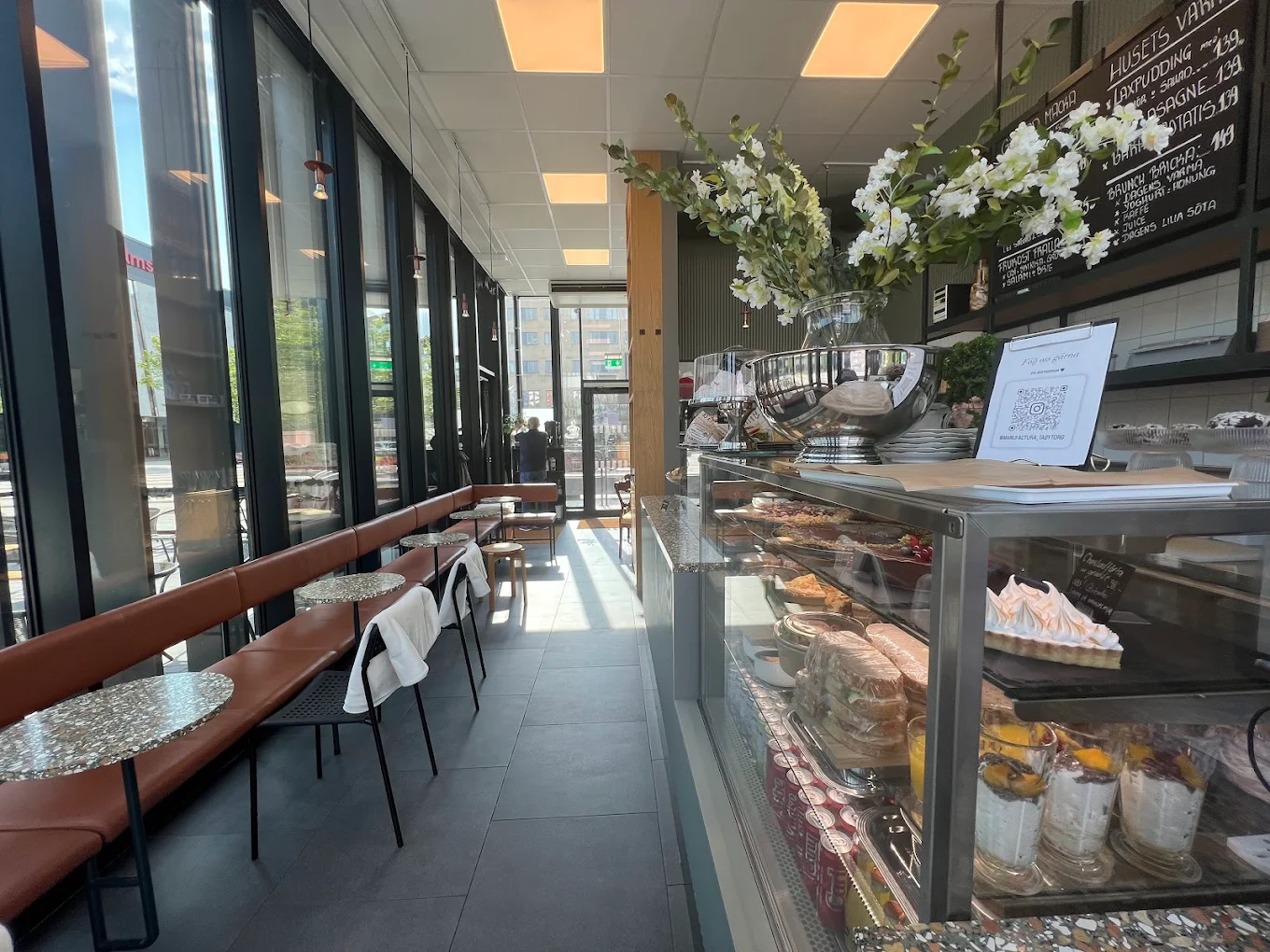
But it has everything you need to have a great “fika”. And the owner made it so cozy and welcoming - obviously awesome.
This is the bar.
The Kaizen of Great Little Software
Don’t like SOAC? Draw inspiration from Gene Kim’s “The Unicorn Project” novel and its five ideals of DevOps:
- Locality and Simplicity
- Focus, Flow and Joy
- Improvement of Daily Work
- Psychological Safety
- Customer Focus
Who didn’t invent it either, but enhanced The Toyota Way built on the idea of kaizen - continuous improvement for the better.
Pick and choose, mix and match - in the end it’s all about placing the software you’re proud of in front of people in need without tricking them into wanting it.
And there are plenty of successful businesses that do just that. But because those businesses don’t have an ambition to conquer the world, you wouldn’t see them as much as those who are driven by fear of abandonment and greed.
Chances are, unless you live where I do, you would never have found out about cafe Manufaktura. And chances are, I don’t know anything about the great little software you built.
But it doesn’t make it any less real, nor does it say anything about its probability of success.