Papra: Your Solution to Document Chaos
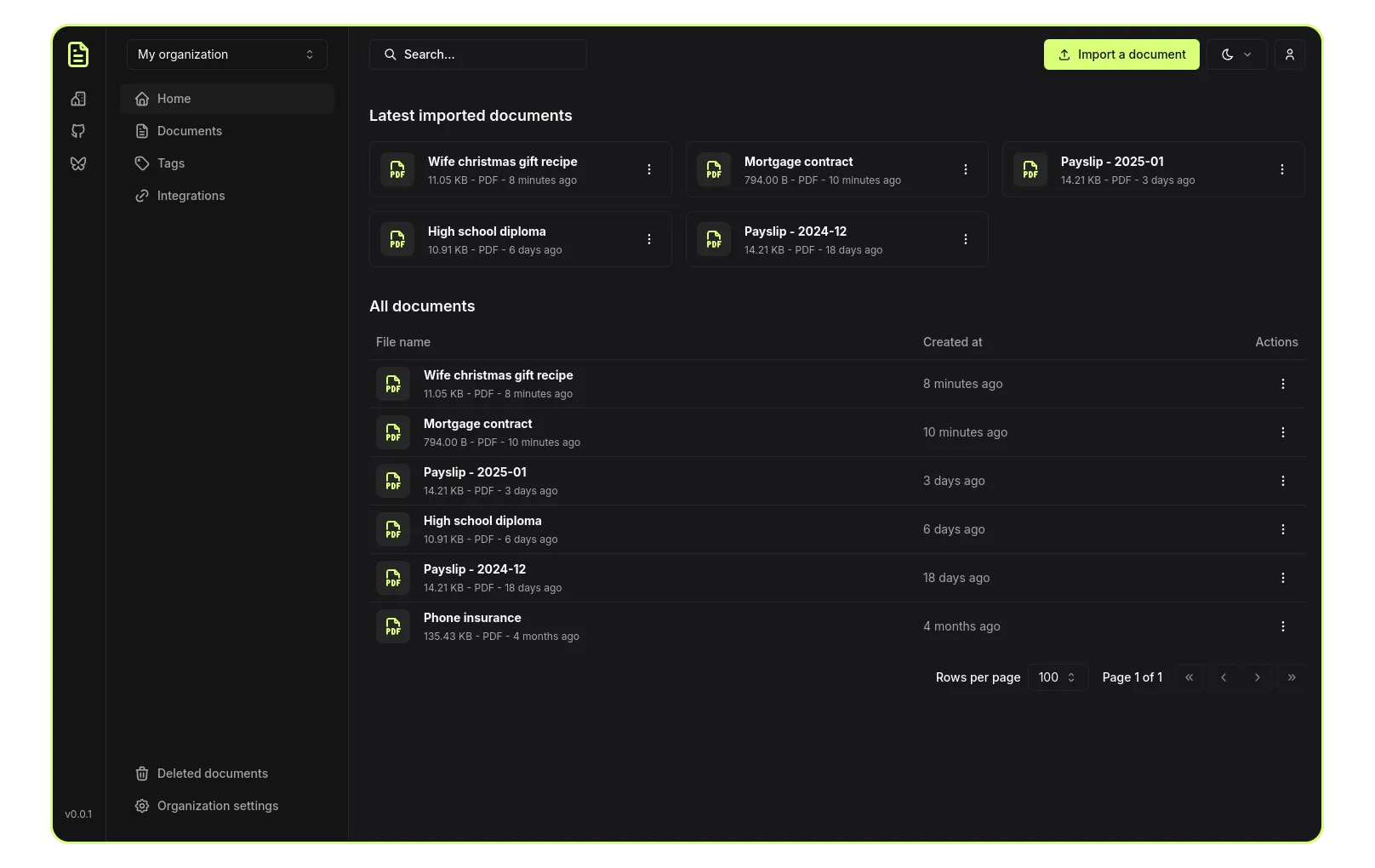
To me, the main non-negotiable point is the ethical aspect of the project. From having everything opensource, to being selfhosting friendly and privacy-focused, no dark patterns, no shady stuff, no monetization of user data, no bullshit. It’s really important for me to build a product that I can be proud of, that aligns with my values, and that make a positive impact, even if it means slower growth or less profit. I’d rather build a smaller sustainable product that treats people well than a bigger one that doesn’t. – Corentin Thomasset
Papra came up in a research that AI agent did for me. It was a very disappointing research, small indie apps built on strong ethical foundation are very hard to find. I think partly because those who make them care more about the apps than the marketing, but mostly because of the sheer volume of yet-another-too-good-to-be-true AI SaaS platform. So when I stumbled upon Papra I got very excited to see the one that made it through the noise!
I was a bit nervous reaching out to Corentin Thomasset, but he turned out a wholesome human being and generously shared his and Papra’s story, that I am so very eager to retell you.
“I’ve started Papra on January 2025 as a side project while still being employed full time” - he shared in his email, “I needed an archiving platform for myself, and I found existing solutions to be either too complex, or not user-friendly enough to be usable by non-technical users (family). So I decided to build something that fits my needs, and hopefully fits others’ too.”
I have a theory why many software projects start this way: I think there’s a lot of correlation between an artist and a software developer and if you think about it this way, you wouldn’t be suprised that a painter painted a sunset view from their backyard - that’s what was available at the time - anything goes, because we can’t resist the call of “what if it could be done better?” even if that would cost years of working after hours with no return, except for the sense of accomplishment.
Luckily, Papra gained traction and within 9 months Corentin was able to fully focus on the project. Let me say it again, he was able to make revenue from an open-source, self-hostable, affordable project!
The Right, The Hard Way
There is a reason why the most common business advice is to solve problems for big companies and charge them exorbitant amount of money: it’s easier and you only have to get a few customers to be able to cover your own salary. An even easier way is to raise money for your idea - you don’t even need to build anything, “just” convince investors that your promises are worth the risk.
It’s an art too, just not the style I personally aspire to. I think that business, just like any form of leadership, is about caring about the people you serve and placing their interests above the sheer profit.
And it was very obvious to me that Corentin shares the same values: “As an open-source and self-hosting advocate, Papra is for me a way to empower people to take control of their own data instead of handing it over to corporations that monetize it. Document archives are deeply personal (tax returns, contracts, medical records, payslips, …) and I think people deserve tools that treat that seriously.”, as he put it - “And, to be honest, I also just love building software. Crafting a product from scratch, solving problems, and learning new things along the way. It’s a very rewarding experience for me, and I enjoy the process as much as the result.”
Guilty, I do too.
One-man-band
Building stuff is fun indeed. Corentin worked with a tech stack he liked and is deeply familiar and enjoys working with. This freedom to choose how, when and what to work on is the greatest benefit of solo development, but there’s the other side of the coin too.
As Corentin put it: “…being a solo founder, you have to wear many hats (every hats to be honest), from development, to design, to marketing, to support, to infrastructure, and more. Every discord ping, every issue, every “it doesn’t work” message, every PR, it’s all on you to handle, and it can be overwhelming at times. But the community around the project has been amazing and supportive, it’s motivating and makes it all worth it.“
Naturally, one would suggest to turn to the all-powerful-LLMs to balance the load out, but I think Corentin has a good point about it: “As a said above, I really enjoy building software, writing code, finding solutions to problems, and crafting stuff with my bare hands, so AI has never had a significant role in Papra’s development. I don’t want the robots doing the fun part for me, or to lose my connection with the codebase.”
He mentioned the famous line by Joanna Maciejewska: “I want AI to do my laundry and dishes so that I can do art and writing, not for AI to do my art and writing so that I can do laundry and dishes.”. Given that I’ve spent the last year trying to tackle this exact problem (never-ending laundry and dishes), I couldn’t agree more.
I’m not anti-AI and my impression is that neither is Corentin. He said that he genuinely tried to make it work, but got frustrated because correcting and re-prompting LLM often takes longer and yields worse results than doing it manually. He uses it for reviews and feedback - as a second pair of eyes and a “safety net, not as a builder”.
Unfortunately, not everyone shares this perspective and like many of open-source maintainers Papra and Corentin are plagued with vibe-coded low-quality contributions, from people, which took them few seconds to prompt and submit. “But on the other side, it takes a lot of time to review, correct, and give feedback on those PRs (feedback which often just gets forwarded back to their agent). It makes it hard not to get a bit sick of AI-generated code.” - he shared.
With great power, comes great responsibility, as Uncle Ben taught us. We just have to hope the latter comes sooner rather than later.
The recipe for success
As of right now, Papra has 4.4K stars on GitHub, which I find very inspiring and see it as a testament to its maker’s abilities and expertise. I asked Corentin if he’d be willing to share his knowledge with us, other solo builders and solo founders, which he did and I believe it’s best that I share his answers verbatim:
“The reality is that my projects are not yet profitable enough for me to fully live off them. I have the chance to have some savings, and can collect some French unemployment benefits for a while. Plus my partner is working full time which is a huge safety net. So I have the huge privilege of being in a comfortable enough position to focus on Papra without the pressure of needing it to pay the mortgage next month, but I’m clear-eyed that this window won’t last forever. At some point, Papra needs to become profitable enough to sustain me, or I’ll go back to a more traditional job and keep building it on the side. That’s just the math.
As for tips and advice, I think the main one is to do this for the right reasons. Trying to build stuff just for the money is a recipe for burnout and disappointment, especially in the early stages when the project is not yet profitable. Building something you care about, that solves a problem you have, that aligns with your values, is what will keep you going through, and make the journey enjoyable regardless of the outcome.
As for marketing it’s indeed a challenge, especially for a solo builder with limited time and resources. It’s clearly not my strong suit, and I don’t have a magic formula for it. But I think being authentic, and engaging with the community in a genuine way is important. It goes with the “do stuff for the right reasons” advice, people can sense when a project is built with passion and care, and that can be a powerful marketing tool in itself. I’d love to grow the team eventually and bring in people with marketing or community-building skills, but for now it’s just me wearing all the hats and doing my best to get the word out while building the product.
In the end, I’d rather build something small that I’m proud of and that genuinely helps people than chase numbers I don’t care about. If Papra ends up being a sustainable one-person product that pays my bills and serves a community of users who care about their data, that’s a huge win. Anything beyond that is a bonus.
So if there’s one thing I’d say to other solo builders: don’t measure yourself against other products outcomes. A profitable, sustainable, one-person product that lets you keep doing work you care about is already a rare and valuable thing. That’s the bar I’m aiming for, and I think more builders should give themselves permission to aim there too.“
What do you wish you’d done differently with the knowledge you have now?
“I’d tell my past self to focus less on making things perfectly perfect from the start. I easily get caught up in the details and try to build the ideal solution, sometimes getting stuck on a problem for too long, or over-engineering things at the cost of shipping and getting feedback. There’s a balance between building something good enough to be useful and obsessing over making it perfect, and I’m still learning to find it. Hard habit to break, but I’m getting better at it.”
What’s your wildest dream for the app?
“I’d love to see Papra become the go-to reference for document archiving, empowering millions of people to take control of their own data, and maybe even inspiring companies to go full open-source and self-hosting along the way. And beyond that: a thriving community of contributors and self-hosters around Papra, where the project belongs to more than just me, with an open governance model. The kind of open-source project that lives beyond its creator, one that will adapt and evolve with the needs of its users. That would be the long-term win.”
I encourage you to try Papra out at papra.app. It is a great little software.